
The hotel ballroom floor was covered with turf. Three dozen horses arrived by elevator. Trays were attached to saddles. The millionaire’s dinner party had begun.
New York’s Cornelius Billings made his money the old fashioned way: he inherited it. Why not host a clever little soirée? The 1903 event cost a mere $1.2 million.
Today, the lifestyles of the rich are even more extravagant. Just eighty miles north of Manhattan in Greenwich, Connecticut, hedge fund managers are building McMansions with 25-car underground garages, indoor waterfalls, regulation basketball courts, and much more.
One billionaire’s home holds $400 million in art and a 14-foot tiger shark floating in a tank of formaldehyde. “America’s a great country,” a Wall Street commuter told Vanity Fair magazine: “I’ve worked hard. I’ve made a few bucks. So I want to build a house for myself. Is that so wrong?”
If the rich have gotten richer–and they have– Connecticut’s low-wage workers still struggle to feed their families and pay the rent. When they get mad, they get organized.
In the first part of the 20th century, Willimanitc textile mills employed whole families–Dad, Mom, and the kids– in order to bring home one meager pay envelope. Boot blacks and news boys in Hartford who worked 80 hours a week organized unions for self-protection. African American “sand hogs” (who dug bridge foundations under the Connecticut River) were forced to strike when they didnt get their pay envelopes. In Windsor, female tobacco workers organized to protest the straw bosses who cheated them at the weighing scales.
These workers often won those battles, but not always. Their sacrifices provided inspiration to other “wage slaves” and better public awareness of who really fuels our economy: workers, not the idle rich, create prosperity.
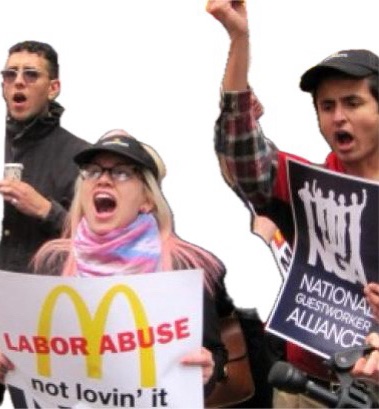
As a result of ground-floor agitation by millions, labor unions won the legal right to organize in July, 1935. The National Labor Relations Act (NLRA or Wagner Act) was a big step in winning justice, but it has also taken civil rights laws, OSHA safety regulations and the 2009 Lillie Ledbetter Fair Pay Act to fortify their defenses against employer assaults. The Connecticut state senate debated a bill giving low-wage workers a fighting chance to make better lives for their families. Last May Day in Hartford, one thousand workers marched and encircled the State Capitol, joining tens of thousands more across the country to demand a living wage and the right to join a union.
Connecticut mega-employers like WalMart and McDonalds pay such low wages their workers must rely on public assistance. A fair wage “fee” to recoup state costs could disappear if the big-box bosses started providing equitable wages and benefits.
Today’s protests by fast food, nursing and home care aides are an upheaval exposing the fault lines of income inequality. Our nation’s poorest workers are shaking the ground. If history is any indicator, there’s plenty more to come.
.

 Shoeleather History Project