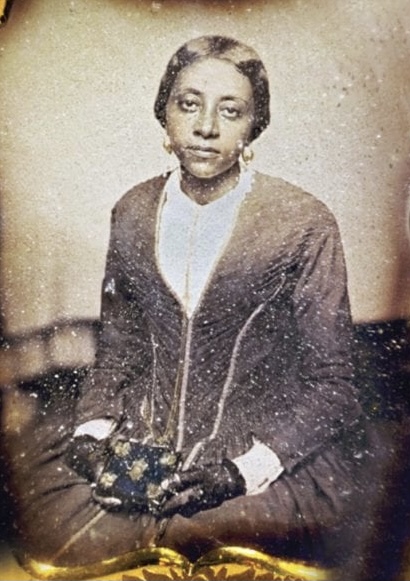
Nancy Jackson was born into slavery. Major James Stephen Bulloch, a successful Georgia businessman, claimed ownership of Jackson. Bulloch owned a cotton mill and two cotton plantations in Roswell, outside of Savannah. His house, Bulloch Hall, was built by slaves and stands today as a historic property and a Roswell tourist destination.
Bulloch moved his family and Nancy Jackson from Georgia to Hartford in 1835 so their daughters could attend school. He traveled back and forth from Connecticut on business while Jackson served the Bullochs.
Major Bulloch found a sympathetic reception in Hartford; many of the city’s most prominent business and religious leaders found it profitable to trade with southern slave owners.
Nancy Jackson found solace in the Talcott Street Congregational Church, the first such religious society organized by local African Americans. She attended the church Sunday School and was befriended by James Mars, a church deacon. Mars was born in slavery, owned by Reverend Amos Thompson of Canaan. Thompson owned land, a farm and two mills in town. James Mars, his parents and siblings were also the preacher’s property.
Eventually, Mars’ family escaped and were on the run for several years. Mars arranged to buy his family’s freedom, established his own business and published an autobiography.
It was no coincidence that Talcott Street should act as a safe harbor for fugitives. Talcott church was a stop on the Underground Railroad.The first church pastor, Rev. Hosea Easton, had fought racism all his life. He spoke, preached, and published against slavery and in favor of reparations until his death in 1837. That was the year Nancy Jackson won her freedom.
Rev. James Pennington then presided over the Talcott Street church; even his congregation did not know he had escaped slavery in 1827 from Maryland and was still on the run from his former captor. Pennington ultimately built an international reputation as an abolitionist. With the help of a Hartford ally, he negotiated with his former master to win his freedom.
We don’t know exactly when Nancy Jackson first decided to publicly challenge her enslavement, but it is likely that her relationship to church members, especially Mars, turned her secret desire into a concrete plan. Mars introduced Jackson to Rev. E.T. Tyler, who with Theodore Weld assisted her in taking her case to court.
Despite her fears, Nancy’s dread of returning to Georgia was a prime motivator. Jackson had once asked Bulloch for her freedom, which he flatly refused. Jackson confided to a supporter that Bulloch instead pledged to spend $500 (over $300,000 today) to track her down if she tried to escape.
Bulloch sent Jackson to speak with Rev. Cornelius C. Vanarsdalen of Hartford’s South Congregational Church. The pastor hectored her, threatening damnation and hellfire if she didn’t renounce her threat to leave Bulloch. Her hunger for liberation was greater than his threats.
While preparing for her day in court, Jackson confided to supporters that the only way she would return as a slave was if she was dead. This was not an idle threat. Nancy Jackson sewed two opium pills in the lining of her dress, figuring they would provide the ultimate escape.
Nancy Jackson charged Bulloch with unlawful confinement and delivered a writ of habeas corpus. At issue was the 1774 Connecticut law that would consider a slave freed if h/she had been “left” in the state by the slave master.
At first, Bulloch argued that Jackson did not want to be emancipated. But Jackson definitively told the court she wanted to be free. Bulloch then called Rev Vanarsdalen, who testified he had heard her express satisfaction with her position as Bulloch’s slave. His statement did not persuade the judges.
The Connecticut State Supreme Court of Errors (as it was then called) decided in a 3-2 decision in Nancy Jackson’s favor. She was a free woman.
As it turned out, Jackson continued to work once again for Mrs. Bulloch, but this time as a paid employee who had the freedom to determine her own future. She later worked for one of Bulloch’s family friends in New York, where she met a young Teddy Roosevelt.
Nancy Jackson wrote to Roosevelt many years later when he became president, just to let him know how she had fared in life. She was 91 years old.
When James Bulloch died in 1849, he bequeathed thirty-one enslaved people to his wife. Nancy Jackson, however, was not one of them.
Poet and cultural critic Bessy Reyna researched Nancy Jackson and wrote “Freedom’s Journey in Four Voices” about her case. It can be found on Vimeo starting around 1:06:55
 Shoeleather History Project
Good morning,
My name is John Mills. I am a genealogist. I’m also the president of a Connecticut-based non-profit. We do research into the formerly enslaved… we then give that history back to current-day descendants. Back in April of 2022, you published an article here about Nancy Jackson… an enslaved woman brought to Connecticut by James and Martha Bulloch in 1837. In researching Nancy, I found a description of her mother, Charlotte, and I have images of two of her 4 siblings. I’ve also met with two of her current-day descendants at Bulloch Mansion in Georgia. I have images of her current-day descendants you can see on Facebook at
Using all of this, I am commissioning a portrait of her, all based on known descriptions and images of her family.
I may be unique in having discovered all of these sources for use in recreating a depiction of Nancy Jackson, but I don’t know if that’s true or not. I noticed you have a re-imagined image of Nancy on this website. Before I start this commission, I want to understand what went into your re-imagined image of her. I don’t want to redundantly do this if you based your reimagined image on similar sources. I recognize we are injecting something new in using images of current-day descendants, but I don’t want to be redundant.
Please let me know.
Thanks,
John Mills
john@alexbreanne.org